

Technology is easy to talk about badly.
It is even tempting to say Altirev is built with modern mobile, web, backend, and cloud technologies. Or even mention the technology stack that built Altirev. But that does not explain the real engineering behind it or its challenges.
The harder question is this:
How do you build a system that can operate in the middle of an election, across hundred of thousands of polling units, under poor connectivity, human pressure, delayed reporting, and possible manipulation attempts, while still giving the public timely visibility?
That is the problem Altirev was built to solve.
Altirev is not just an election app. It is an election monitoring and intelligence platform designed around the realities of Nigerian elections: Field reporting, offline conditions, collation delays, result inconsistencies, public trust, and the need for real-time visibility.
The technology matters. But the most important part is not the stack itself.
It is the system design.
Why Election Technology Is Different

Most digital platforms are built around predictable user behavior.
Election systems are not.
During an election, activity does not spread evenly across the day. It comes in waves. Multiple reports may go viral at once, agents may submit evidence from remote polling units with weak internet. Public observers may rush to the platform when results begin to appear. Thousands of agents may unknowingly submit heavy video evidences at the same time. Agents may need to submit information quickly before leaving a location.
At the same time, accuracy matters more than speed alone.
A social media app can tolerate a delayed post. An election monitoring system cannot treat result integrity casually.
This means Altirev had to be designed around five realities:
- Connectivity will not always be reliable.
- Field data must be captured close to its source.
- Public visibility must be fast.
- Sensitive operational workflows must be protected.
- Results must be checked across multiple levels, not accepted blindly.
That is why Altirev’s technology is built around selective depth: deep enough to be transparent about the engineering philosophy, but careful enough not to expose sensitive implementation details that could weaken the platform.
Mobile-First Because Elections Happen in the Field
Altirev’s field experience is built around mobile use.
Agents, Collation Officers, Observers, and election participants are not sitting in perfect office conditions with stable broadband. They are often at polling units, collation centers, or moving between locations.
That is why the mobile layer is central to the platform.
Altirev uses mobile technology to support field-level workflows such as:
- submitting polling unit reports
- capturing result-related information
- uploading supporting evidence
- working under unstable network conditions
- syncing data when connectivity becomes available
The important part is not simply that Altirev has a mobile app. The important part is that the mobile experience is designed for election conditions.
A field agent should not lose critical data because the network drops. A report should not become useless because it was captured in an area with poor coverage. A system designed for elections must assume imperfect conditions from the start.
That is why offline-first thinking is part of Altirev’s foundation.
Offline-First Does Not Mean Offline Forever
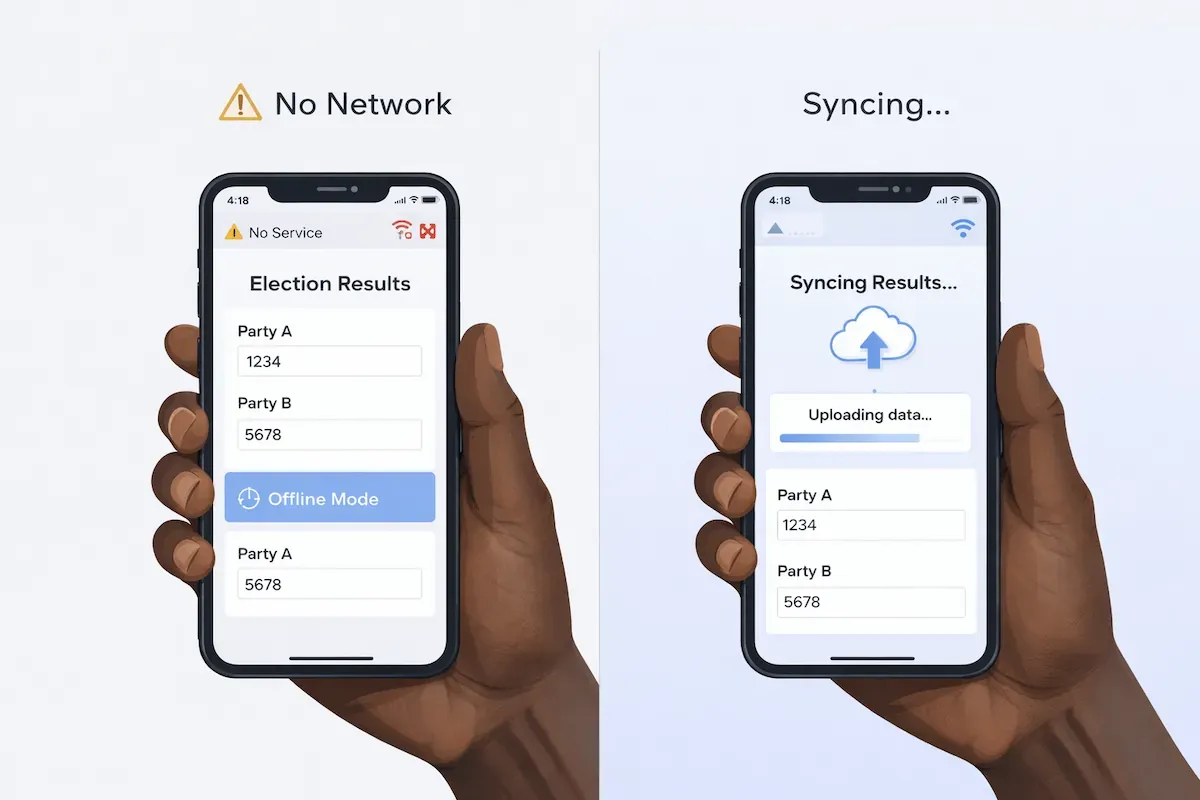
Offline-first means the system can continue to capture important information even when internet access is weak or temporary.
But offline-first also creates a harder engineering challenge: synchronization.
When data is captured offline, the platform must later decide how that data should be submitted, validated, ordered, and reconciled.
This is where election technology becomes more complex than ordinary form submission.
Altirev’s approach is built around controlled synchronization. The goal is not just to “send later.” The goal is to make sure delayed submissions still enter the system in a way that preserves traceability, and reviewability.
In election monitoring, timing matters. Source matters. Location matters. Role matters. Evidence matters.
So the platform cannot treat all incoming data as equal. It has to understand where the data came from, who submitted it, what election context it belongs to, and how it compares with other submissions.
That is the difference between a normal reporting app and an election intelligence system.
Real-Time Visibility Without Losing Control
One of Altirev’s key goals is public visibility.
The public should not have to wait until the end of the entire collation process before seeing what is happening. Election information becomes more useful when it is visible early, structured properly, and updated continuously.
But real-time visibility has to be handled carefully.
There is a difference between making public data fast and exposing sensitive operational systems.
Altirev separates public-facing experiences from operational workflows. Public users need speed, availability, and clarity. Internal users need controlled access, role-based permissions, and stronger validation.
That separation matters.
It allows Altirev to serve public traffic efficiently while keeping sensitive workflows protected. It also means the system can scale differently for different audiences.
The observer viewing public updates is not the same as the agent submitting polling unit evidence. The moderator reviewing role assignments is not the same as a collation officer submitting official totals.
Each role has a different trust level. The technology reflects that.
Role-Based Trust Is Central to the Platform
Altirev is built around different election roles because election data does not come from one kind of user.
There are public observers. There are field agents. There are collation officers. There are validators. There are moderators. There are stakeholders.
Each role has a different responsibility.
This is important because election integrity depends on controlled participation. A system where everyone can do everything is dangerous.
Altirev uses role-based access control (RBAC) to ensure that users can only perform actions appropriate to their function.
For example, someone observing public results should not have the same access as someone submitting polling unit data. Someone assigned to one operational scope should not automatically control another scope.
This is not just a security decision. It is a governance decision. The platform has to mirror the structure of the election process itself.
From Polling Unit to Collation: Why Data Layers Matter

Election data does not end at the polling unit.
In Nigeria’s electoral process, results move from polling units to ward collation, then to LGA, state, and national collation depending on the election.
This layered movement creates opportunities for delay, human error, interference, and manipulation.
Altirev is designed to follow this structure.
Instead of treating election results as one flat dataset, the platform understands that data exists at different levels:
- polling unit level
- ward level
- LGA level
- state level
- national level
That layered structure allows Altirev to compare information across stages.
If data submitted from one level does not align with what appears at another level, the system can automatically flag the inconsistency for review.
This is where Altirev begins to move beyond reporting and into intelligence.
The Election Intelligence Engine (EIE)
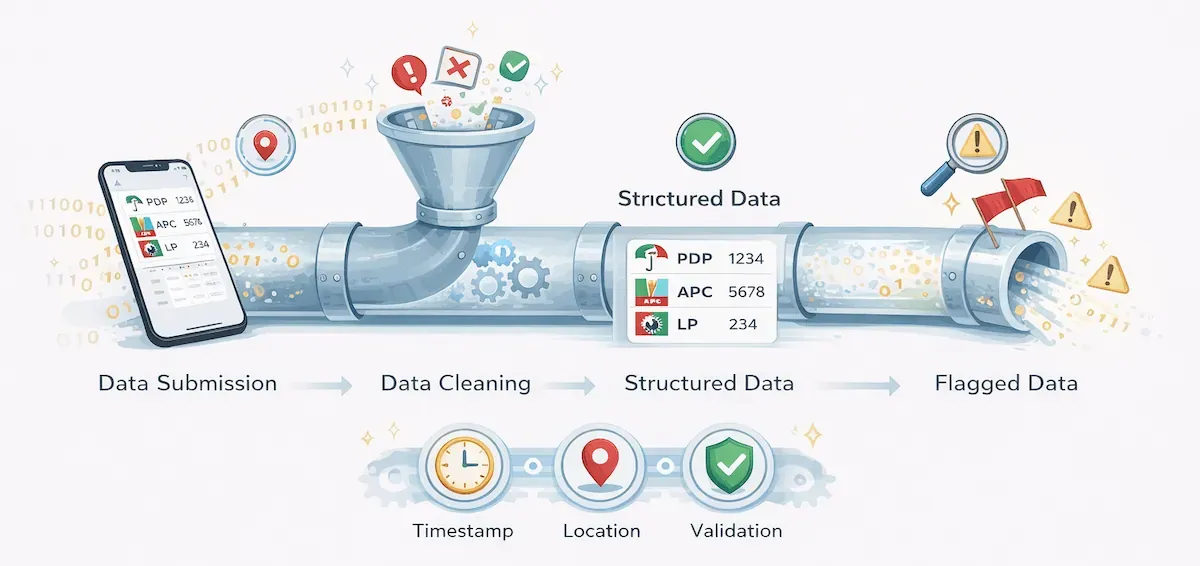
At the heart of Altirev’s deeper technology is the Election Intelligence Engine, also called EIE. Pronounced "Eye".
The EIE is designed to help identify inconsistencies, unusual patterns, and possible discrepancies across the election data chain.
The goal is not to replace human judgment. The goal is to support it with credible, data-driven signals that highlight where attention is needed most.
Election data can be noisy. Mistakes can happen. Reports can arrive late. Evidence can require review. But when inconsistencies appear across polling unit, ward, LGA, state, or national data, the system does not ignore them, it flags, correlates, and surfaces them in context, enabling faster review, stronger verification, and more confident decision-making.
The EIE helps Altirev ask important questions:
- Does this result align with earlier submissions?
- Are totals consistent across levels?
- Is there a mismatch between field data and collation data?
- Are there signs that a disrupted polling unit is being treated as valid elsewhere?
- Does the data pattern require review?
The exact internal rules and thresholds are not public for security reasons. But the principle is clear:
Altirev does not simply collect election data. It compares, validates, and contextualizes it across every layer of collation.
Evidence Matters
Election reports are stronger when they are supported by evidence.
That evidence may include images, documents, videos, or other field-captured material. But handling evidence at scale is not just about allowing uploads.
Evidence must be tied to the right user, the right election, the right location or assignment context, and the right submission.
A weak evidence system becomes a dumping ground. A strong evidence system becomes part of the verification chain.
Altirev treats evidence as part of the integrity model.
This matters because election disputes often come down to proof. A report without supporting material may raise concern. A report with structured evidence becomes more useful to reviewers, observers, and stakeholders.
Public Speed, Internal Discipline
Altirev has two responsibilities that often compete with each other:
The public wants speed.
The system needs discipline.
If the platform is too slow, people lose trust. If it is too careless, people lose trust for a different reason.
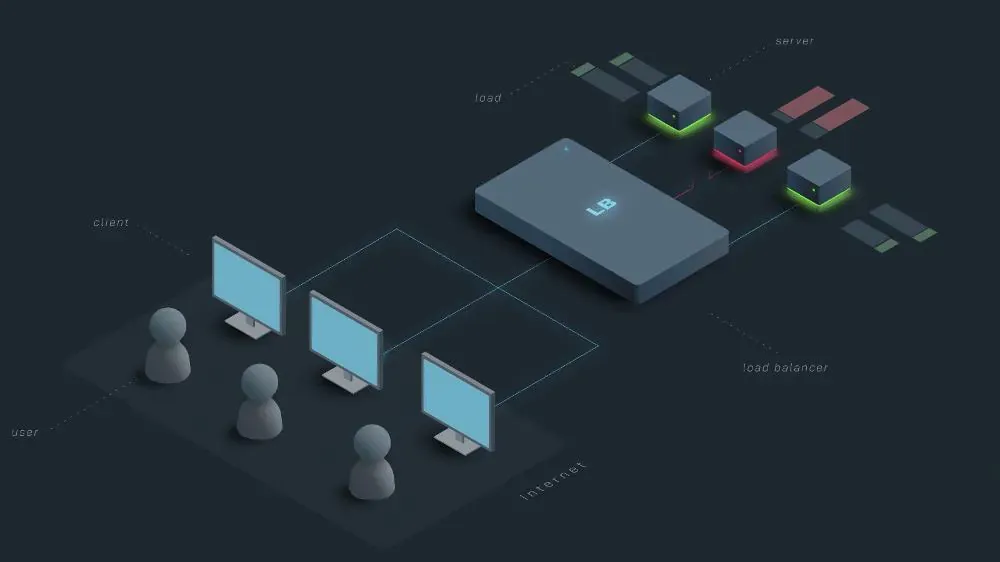
That is why Altirev is designed to provide fast public visibility while keeping internal workflows more controlled.
Public-facing pages such as reports, results, and live stream are optimized for quick access. Operational areas such as agent, collation, assignments, validation, moderation, and command center are treated with stricter control.
This balance is important.
Election technology should not be reckless in the name of speed. But it also should not hide behind slow bureaucracy when people need visibility.
Altirev’s design tries to hold both truths at once.
Why the Stack Still Matters
The stack matters, but only because it supports the product philosophy.
Altirev uses modern mobile and web technologies to deliver a fast user experience across devices. It uses a backend architecture designed to handle structured election workflows, role-based access control, media handling, real-time updates, and high-traffic public reads.
React Native supports the mobile field experience.
Altirev’s web platform uses React and TypeScript to deliver fast, responsive dashboards and observer-facing interfaces at scale.
Node.js supports the backend layer that coordinates APIs, workflows, validation logic, and real-time behavior.
Cloud infrastructure supports availability, scaling, and separation between different parts of the system.
But the stack is not the headline. The headline is what the stack enables:
- field reporting
- offline resilience
- real-time visibility
- role-based permissions
- evidence-backed submissions
- collation-level comparison
- anomaly detection
- public transparency
That is the technology story that matters.
Designing for Election-Day Pressure
Election day is not normal traffic.
A platform may be quiet in the morning and heavily used in the evening when results begin to emerge. Public interest can spike suddenly. Field submissions may arrive in bursts. Live stream may become the center of attention.
Altirev is designed with this pressure in mind.
The system must serve public users quickly while allowing agents and operational users to keep working. It must avoid letting public traffic interfere with sensitive internal processes.
This is why separation is a recurring theme in Altirev’s architectural design.
Different users. Different workflows. Different traffic patterns. Different trust levels.
Trying to force all of that through one simple path would be technically disastrous.
Altirev is built to avoid that.
Transparency Without Carelessness
There is a reason this article does not publish Altirev’s internal diagrams, security rules, infrastructure configuration, or exact anomaly detection logic.
Election technology has to be transparent about its purpose, principles, and accountability model. But it should not expose details that make abuse easier.
A serious platform must know the difference between public trust and operational exposure.
So Altirev’s position is simple:
We will explain what the system is designed to do.
We will explain the engineering principles behind it.
We will explain why the architecture exists.
But we will not publish sensitive implementation details that could weaken the platform or help bad actors game the system.
The Bigger Vision

Altirev is building more than software.
It is building a verification infrastructure for electoral transparency.
That requires more than a beautiful interface. It requires systems thinking. It requires field awareness. It requires security discipline. It requires understanding how elections actually work on the ground.
The future of election monitoring will not be defined only by people watching from a distance. It will be defined by platforms that can collect, verify, compare, and present election data in ways the public can understand and institutions can take seriously.
That is the direction Altirev is moving toward.
Download Altirev on App Store and Google Play Store. Sign Up to become a trusted election Observer.
Next read 👉 When the Internet Goes Off, Democracy Must Go On.