
Election monitoring in Nigeria has evolved significantly over the years, yet core challenges around transparency, speed, and verification remain unresolved.
From manual observation methods to structured collation systems and emerging real-time platforms, different approaches attempt to ensure electoral integrity. However, not all solutions offer the same level of reliability or visibility.
This guide explores the major election monitoring solutions in Nigeria, how they work, and why real-time systems are beginning to redefine the standard.
What is Election Monitoring?
Election monitoring refers to the process of observing, documenting, and verifying electoral activities to ensure they are conducted fairly and in accordance with established guidelines.
In Nigeria, this typically includes:
- Monitoring polling unit activities
- Recording official results declared in forms (EC8A - EC8E)
- Tracking collation processes across Polling Unit, Ward, LGA, State, and National levels
- Reporting irregularities
The goal is simply to ensure that what happens at the polling unit is accurately reflected in final results.
Challenges in Nigeria’s Electoral Process

Despite structured procedures, several weaknesses persist:
Delayed Result Transmission
Results are often physically transported before collation, introducing delays and opportunities for interference.
Multi-Level Collation Risks
Data is manually aggregated across:
- Polling Unit (EC8A)
- Ward (EC8B)
- LGA (EC8C)
- State (EC8D)
- National (EC8E)
Each stage introduces risk of inconsistency or manipulation.
Lack of Real-Time Verification
Most systems do not allow stakeholders to verify results as they are generated.
Fragmented Monitoring
Observers, agents, collation officers, and institutions often operate in silos, limiting data cohesiveness and consistency.
Types of Election Monitoring Systems

Manual Observation Systems
Traditional observer-based monitoring where reports are submitted after events occur.
- Strength: Widely adopted
- Weakness: Slow and reactive
Parallel Vote Tabulation (PVT)
Used by civil society organizations like Yiaga Africa, PVT involves independent vote counting based on sampled polling units.
- Strength: Statistical verification
- Weakness: Limited scope and not real-time.
Institutional Monitoring Systems
The Independent National Electoral Commission (INEC) operates structured systems such as result collation frameworks and digital support tools.
- Strength: Official and authoritative
- Weakness: Centralized control, limited transparency.
Real-Time Digital Monitoring Platforms
Emerging platforms introduce real-time data capture, verification, and public visibility.
- Strength: Immediate transparency
- Weakness: Requires infrastructure and adoption
Leading Election Monitoring Solutions in Nigeria
INEC Monitoring Systems
INEC oversees the official election process, including:
- Result documentation (EC8 series forms)
- Collation workflows
- Regulatory oversight
While authoritative, visibility into the process is often non-transparent and delayed until final announcements.
Civil Society Monitoring Initiatives
Organizations like Yiaga Africa provide independent verification through structured observation and PVT methodologies. Yiaga Africa deploys 10,000+ trained observers across 25,000+ polling units nationwide.
Given Nigeria’s scale, with over 176,000+ polling units, this approach focuses on statistically representative coverage rather than full nationwide presence. It plays an important role in strengthening accountability and validating electoral outcomes.
While aspects of data collection may occur in real-time within this sample, public visibility is generally provided in aggregated or summarized form rather than as continuous, nationwide live data. This makes PVT-based systems a strong complement to emerging real-time platforms that aim to provide broader, more immediate visibility across the entire electoral process.
Real-Time Monitoring Platforms (Altirev)
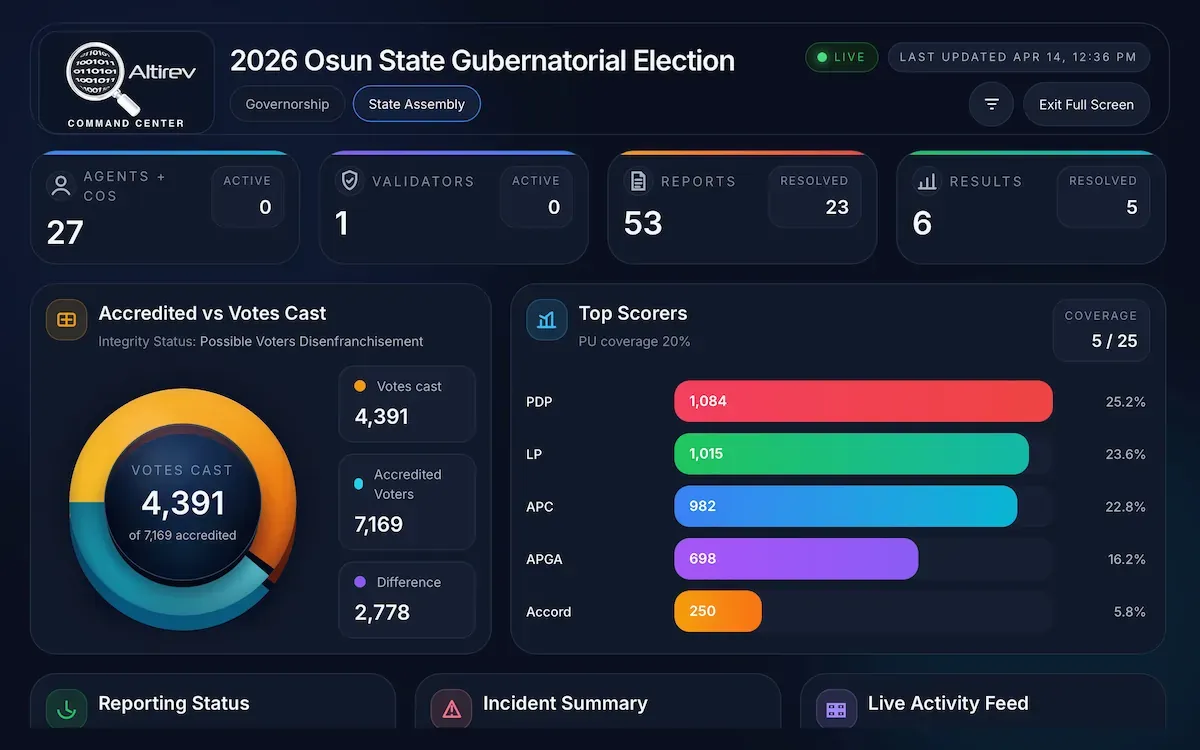
Platforms like Altirev represent a shift toward:
- Live polling unit reporting
- Instant data transmission
- Cross-level verification (PU → Ward → LGA → State → National)
- Public visibility of reports and results
Unlike traditional systems, real-time platforms reduce the gap between event occurrence and data availability.
To better understand how Altirev works and its role in election monitoring, read our in-depth guide: What is Altirev? A Complete Guide
Why Real-Time Monitoring is the Future
The core limitation of traditional election monitoring is not structure, it is timing.
When data is delayed:
- Narratives form before verification
- Irregularities become harder to challenge
- Transparency is reduced
Real-time systems change this by:
- Capturing data instantly at polling units
- Making results visible as they are submitted
- Allowing immediate detection of inconsistencies
This shift transforms election monitoring from a reactive process into a continuous verification system.
How to Evaluate an Election Monitoring Platform
When assessing any election monitoring solution in Nigeria, key factors include:
Speed
How quickly is data captured and transmitted?
Transparency
Can stakeholders independently verify results?
Coverage
Does the system scale across polling units and collation levels?
Data Integrity
Are there mechanisms to detect inconsistencies?
Accessibility
Can the public access and understand the data?
Election monitoring in Nigeria is at a transition point.
Traditional systems provide structure.
Civil society initiatives provide independent oversight.
But real-time platforms introduce something fundamentally different: Immediate transparency.
As electoral expectations evolve, the effectiveness of any monitoring solution will increasingly depend on its ability to provide fast, verifiable, and accessible data.
Download Altirev on App Store and Google Play Store. Sign Up to become a trusted election Observer.
Next read 👉 Building Altirev: The Technology Behind The Platform